

It slips because time is consumed quietly—across many small decisions that buyers often do not see.
From the buyer’s perspective, production seems straightforward: approve the formula, place the order, and wait for delivery. From the manufacturer’s perspective, timelines stretch and compress based on how decisions, changes, and assumptions interact throughout the project.

This article explains where time actually gets used in the supplement manufacturing timeline, and why delays usually reflect process friction rather than inefficiency.
Timeline Expectations Are Set Before Production Begins
Most timeline issues originate early.
Buyers often form timeline expectations before feasibility, sourcing, or packaging details are finalized. These early assumptions become reference points—even when project scope changes later.
Once expectations are set too early, any adjustment feels like a delay, even if the timeline reflects real manufacturing requirements.
Decision Latency Is a Major Hidden Time Cost
One of the most underestimated factors in the supplement manufacturing timeline is decision latency.
Manufacturing progress depends on timely approvals:
-
Formula adjustments
-
Packaging selections
-
Label confirmation
-
Market-specific compliance details
When decisions pause, production does not move sideways—it stops. Small approval delays accumulate into significant timeline extensions without appearing as “active delays.”
Raw Material Readiness Shapes the Middle of the Timeline
The supplement manufacturing timeline is often constrained by material readiness rather than production capacity.
Ingredients may be available, but not qualified. Packaging may be sourced, but not approved. Testing may be scheduled, but not completed.
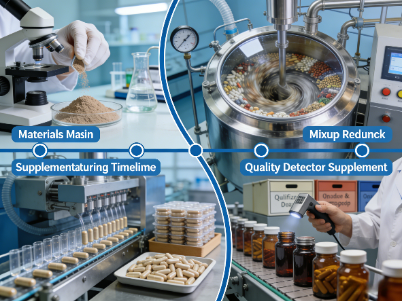
These dependencies create waiting periods that are invisible from the outside yet critical to timeline accuracy.
Changes Do Not Reset the Timeline—They Rewire It
Buyers sometimes assume that small changes cause small delays.
In reality, changes reconfigure dependencies. A minor formulation adjustment may affect stability assumptions, packaging compatibility, or testing requirements. Each downstream dependency must realign before progress resumes.
This is why late-stage changes often extend timelines disproportionately.
Parallel Processes Are Not Always Truly Parallel
Manufacturers often run multiple steps in parallel to compress timelines.
However, parallel processes still rely on shared inputs. When one stream pauses—such as regulatory review or material confirmation—others may stall despite appearing independent.
The supplement manufacturing timeline advances only as fast as its most constrained dependency.
Why Samples Do Not Predict Production Timelines
Samples create a false sense of speed.
They are produced under controlled conditions, outside standard production scheduling. While useful for validation, samples do not reflect real queueing, batching, or resource allocation.
Basing timeline expectations on sample speed often leads to unrealistic assumptions once full production planning begins.
Production Capacity Is Rarely the Bottleneck Buyers Expect
Contrary to common belief, production lines are not always the main constraint.
More often, timelines are shaped by:
-
Documentation readiness
-
Testing turnaround
-
Packaging coordination
-
Approval sequencing
Production itself may represent only a fraction of total project time.
Why Experienced Buyers Move Faster Without Rushing
Experienced buyers shorten timelines not by demanding speed, but by reducing friction.
They:
-
Prepare decisions earlier
-
Limit late-stage changes
-
Align internal stakeholders before production starts
As a result, the supplement manufacturing timeline progresses more smoothly—even when absolute production speed remains the same.
Viewing the Timeline as a System, Not a Schedule
Timelines behave like systems.
They respond to inputs, constraints, and interactions rather than fixed dates. When buyers understand how time is actually consumed, they can plan more realistically and avoid unnecessary escalation.
Reliable timelines come from alignment, not pressure.