

Softgel capsule manufacturing looks straightforward from the outside. A liquid formula goes into a machine, two gel ribbons come together, and finished capsules come out.
The actual work starts earlier.
Before the machine runs, the manufacturer needs to know whether the fill will remain uniform, whether it can be pumped accurately, and whether it will stay compatible with the shell. A formula can look perfectly stable in a small mixing vessel and still settle, leak, or change the shell during a full production run.
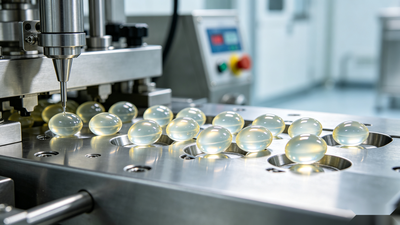
The rotary die machine is an important part of the process, but it cannot fix a formula that was never suitable for a softgel in the first place.
What Happens Before the Machine Starts
Capsule size and color are often discussed too early.
For a new softgel project, the first review is usually about the fill itself. Is it a clear oil, a solution, or a suspension? How thick does it become at production temperature? Does it stay mixed, or does material begin collecting at the bottom of the tank?
These questions affect almost every decision that follows.
A simple oil blend is generally easier to handle. A suspension containing powdered actives can be more demanding. The particles need to be small enough to move through the filling system, but they also need to stay evenly distributed during the run.
A small sample can be misleading here. It may be mixed and filled within a few minutes. During commercial production, the same material may remain in a holding tank or feeding system for several hours.
That is often when settling begins to show.
If the suspension is not stable enough, the capsules made at the beginning of the batch may not match those made later. Continuous agitation can help, but it cannot rescue every formula. Sometimes the carrier system, particle size, or active load needs to be adjusted.
The fill and shell have to work together
A standard gelatin softgel shell contains gelatin, purified water, and a plasticizer such as glycerin or sorbitol. Color or an opacifying ingredient may also be added.
The shell is flexible because it retains a controlled amount of moisture. That moisture can move after encapsulation, especially when the fill contains ingredients that attract water or interact with the shell.
Some fills soften the shell. Others make it harder over time. Certain solvents, highly water-soluble ingredients, or reactive components may create problems that are not visible during the first few days.
When we review a new formula, appearance is only one part of the decision. We also look at how the fill behaves at production temperature, whether it can remain uniform, and whether any ingredient is likely to affect the shell during storage.
The useful question is not whether a capsule looks good on the day it is made. It is whether it still holds its shape and seal after the fill and shell have been in contact for weeks or months.
How Softgel Capsules Are Manufactured
Once the formula and shell system are considered workable, production can move forward.
The process varies slightly between products, but most softgel lines follow the same basic sequence.
Preparing the shell and fill
The shell mass and fill material are prepared separately.
For the shell, gelatin, water, plasticizer, and any approved color ingredients are heated and mixed until the mass becomes smooth and uniform. Air bubbles need to be removed before the material reaches the encapsulation line.
The shell mass must also be held within a usable temperature and viscosity range. If it becomes too thick, it may not form an even ribbon. If it is held under heat for too long, its processing behavior can change.
The fill is prepared in another vessel.
A simple oil formula may need little more than controlled blending and filtration. A suspension can require heating, milling, or continuous mixing to keep the active ingredients from settling before encapsulation.
Air trapped in the fill can also create problems. It may affect dosing accuracy or leave visible bubbles inside the capsule. For oxidation-sensitive oils, handling time, temperature, and air exposure deserve closer control.
The fill is then transferred to the encapsulation machine while the shell mass is fed to two spreading boxes.
Rotary die encapsulation
The shell mass is spread across two cooled drums, forming two continuous gel ribbons.
These ribbons move toward a pair of rotating dies. The fill is delivered through a heated injection wedge positioned between them.
As the dies rotate, several things happen almost at once:
-
The capsule pockets take shape.
-
A measured amount of fill enters each pocket.
-
The two ribbons are pressed together.
-
The capsule is sealed and cut from the surrounding ribbon.
This is the main difference between a softgel and a hard-shell capsule. The softgel is formed, filled, and sealed in one continuous operation.
During production, the line operator watches the relationship between ribbon thickness, fill volume, wedge temperature, die alignment, and seam formation.
These settings are connected. A thinner ribbon may run well for one product but create a weak seam for another. If fill reaches the sealing area, the capsule may leak immediately or fail later in the bottle.
The first few minutes of a run are usually spent making adjustments. Once the capsules look acceptable, operators still continue checking fill weight, seam quality, and appearance throughout the batch.
A good start does not guarantee a consistent finish.
Drying and inspection
Fresh softgels are soft when they leave the rotary die machine. They contain more moisture than the finished capsule and can easily stick together or lose their shape.
The first drying stage usually takes place in tumble dryers. Conditioned air moves through the rotating drums while the capsules turn continuously. This removes part of the moisture and helps prevent the capsules from sticking to one another.
The capsules are then moved to trays or a controlled drying area.
Drying is one of the stages that looks simple on paper but causes many real production problems.
A large capsule does not dry like a small one. A clear oil fill may behave differently from a dense suspension. Room humidity, airflow, tray loading, and shell composition all affect how long the process takes.
Operators do not stop drying simply because the capsules look firm.
If the shell retains too much moisture, the finished capsules may feel soft or begin sticking in the bottle. If too much moisture is removed, the shell can become brittle and crack during handling.
Uneven drying may produce wrinkled capsules or variation across the same batch. This is why drying records and room conditions matter as much as the visual appearance of the capsule.
Once drying is complete, the capsules are sorted and inspected. Misshapen, leaking, flat, joined, or heavily marked capsules are removed. Surface oil or processing residue may also be cleaned before testing and packaging.
Testing and packaging
The final testing plan depends on the formula and target market.
Typical checks may include fill-weight variation, identity, assay, microbial limits, heavy metals, disintegration, and appearance. Oil-based products may also require oxidation-related testing, depending on the ingredient.
Packaging needs to match the product.
A softgel may leave the production area in good condition and still change later if the bottle, closure, storage temperature, or humidity is unsuitable. For some formulas, protection from oxygen or moisture is more important than the appearance of the bottle.
The packaging decision should therefore be made with the formula and stability plan in mind, not only with shelf presentation.
Problems That Often Appear Later
Some softgel problems are visible as soon as the capsules leave the machine. Others appear after drying, packaging, transport, or several weeks in storage.
| Problem | What may be visible | What may be happening |
|---|---|---|
| Leakage | Oil inside the bottle or around the capsules | Weak seam, fill in the sealing area, shell-fill incompatibility, or handling damage |
| Capsules sticking together | Clumps in the bottle | Incomplete drying, high humidity, or unsuitable shell moisture |
| Wrinkled capsules | Uneven or collapsed surfaces | Unbalanced drying or moisture movement |
| Brittle shells | Cracks during handling | Excessive drying or low storage humidity |
| Fill separation | Sediment or uneven appearance | Poor suspension design or insufficient mixing |
| Variable capsule size | Visible differences between units | Fill-pump, ribbon, or die-setting variation |
Leakage gets the most attention because it is easy to see, but it does not always start on the machine.
When capsules begin leaking in the bottle, the encapsulation line is only one place to check. The investigation may also include the fill formula, shell moisture, drying record, packaging seal, and storage history.
The same is true for sticking.
Capsules that leave the drying room in acceptable condition may still stick together after they spend time in a warm or humid warehouse. That does not always mean the bottle is defective. The shell may have been left with too much moisture, or the packaging may not provide enough protection for the storage environment.
Fill separation is another issue that may be missed during sample development.
A suspended ingredient can look uniform in a freshly mixed sample but settle gradually during a longer production run. Continuous agitation helps, but the formulation still needs enough physical stability to remain consistent between the first capsule and the last.
Gelatin and Vegetarian Softgels
Gelatin remains the most established shell material for softgel manufacturing. It runs well on conventional rotary die equipment and is familiar to most manufacturers.
Vegetarian softgels use plant-based film-forming systems. Depending on the supplier and technology, these may include starches, carrageenan, gums, or combinations of different materials.
The choice affects more than the ingredient statement.
Vegetarian shells may require different preparation temperatures, sealing conditions, drying settings, or storage controls. They can also involve different raw-material costs and minimum production quantities.
For brands serving vegan or vegetarian markets, a plant-based shell may be necessary. For other projects, gelatin may provide a simpler and more established production route.
The decision should be based on the target market, formula, manufacturing capability, and stability requirements. Replacing gelatin is not simply an ingredient substitution.
Why a Good Sample Can Still Fail at Scale
A small sample run is useful, but it does not reproduce every condition of commercial production.
In a sample run, the fill is often prepared in a smaller vessel and used quickly. At commercial scale, it may remain in the mixing and feeding system much longer.
That extra time can expose settling, viscosity changes, foaming, or temperature sensitivity that did not appear during sampling.
Drying also changes with scale. A few trays of capsules do not behave exactly like a full drying load. Airflow, tray position, and room humidity become more important when more product is moving through the same space.
The first commercial batch usually tells us more than the sample.
The fill remains in the system longer. The drying load is larger. Small variations in sealing, ribbon thickness, or suspension uniformity become easier to see.
For this reason, a sample should confirm more than capsule color and shape. It should use the intended fill, shell system, capsule size, and fill weight whenever possible.
A simplified sample may look good, but it does not provide much evidence about how the final formula will perform.
What Buyers Should Ask a Softgel Manufacturer
A quotation can show price, MOQ, and lead time. It does not show how the manufacturer approached the formula.
Before commercial production, four questions are especially useful.
Is the formula suitable for a softgel?
Ask whether the manufacturer has reviewed solubility, suspension stability, fill viscosity, capsule size, oxidation risk, and shell compatibility.
A simple “yes, we can make it” is not the same as a formulation review.
Is encapsulation done in-house?
Some suppliers manage the project but send the softgel production to another factory.
That arrangement may still work, but the buyer should know which facility performs the encapsulation, drying, testing, and packaging. It should also be clear where the production and quality records are held.
What does the sample actually represent?
Confirm whether the sample uses the final active levels, carrier system, shell material, color, capsule size, and fill weight.
If the manufacturer uses a substitute oil or a lower active load only to show the capsule appearance, that should be understood before approval.
Which controls and tests are included?
Ask how fill weight, seam quality, shell condition, drying, and visual defects are checked during production.
Also confirm which finished-product tests are included in the quotation and which require an outside laboratory.
The answer should be specific to the formula. A generic testing package may not cover the risks of every oil, botanical, or suspended active.
Final Thoughts
Softgel production is often described as a machine process, but many failures begin before the machine is turned on.
A fill that settles too quickly will not become stable because it is inside a capsule. A shell and fill that interact badly may still look fine during the first inspection. Capsules that are dried too quickly or too slowly may not show the damage until they are already packed.
A reliable project starts with a workable formula, then carries that formula through encapsulation, drying, testing, and packaging under controlled conditions.
For buyers, the most useful signs are not polished samples or broad claims about quality. Look at how the manufacturer evaluates the formula, what it checks during production, and how it handles the first commercial batch.
That is where the real manufacturing capability becomes visible.
Frequently Asked Questions
How are softgel capsules manufactured?
Softgels are usually made on a rotary die machine. Two gel ribbons enter the machine while a measured amount of liquid or semi-solid fill is injected between them. The dies form, seal, and cut the capsules in one operation. The fresh capsules are then dried, inspected, tested, and packaged.
Can any liquid be filled into a softgel?
No. The fill has to be suitable for pumping, dosing, and long-term contact with the shell. Water content, solvents, viscosity, particle size, oxidation, and ingredient migration can all affect whether the formula is workable.
Why do softgel capsules leak?
Leakage may come from a weak seam, fill contamination in the sealing area, physical damage, poor drying, or interaction between the shell and fill. Some leaks appear during production, while others develop during storage or transport.
How long does custom softgel manufacturing take?
The timeline depends on formula review, sampling, raw-material availability, shell requirements, testing, packaging, and document needs. A new suspension or plant-based shell project usually requires more development than an established oil formula.