

Creatine is one of the most widely used ingredients in the sports nutrition industry, but many buyers, brand owners, and even end consumers do not really know what happens before the finished product reaches the shelf.
The short answer is that creatine supplements are not simply “mixed and packed.” A reliable creatine product goes through a chain of steps that includes raw material sourcing, identity testing, formulation review, blending, filling, packaging, and final quality checks. The details matter, because creatine is a category where small differences in raw material quality, processing control, and packaging decisions can affect flowability, taste, moisture stability, and customer experience.
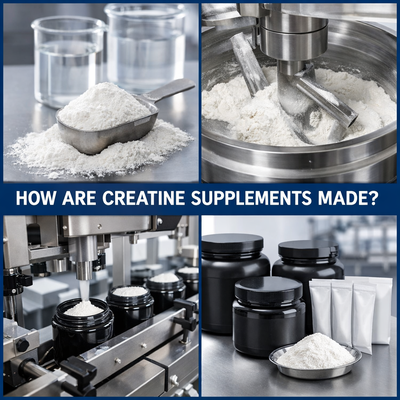
If you are asking how creatine supplements are made, it helps to look at the process from a manufacturing point of view rather than just from a label claim point of view.
What Is the Starting Material for Creatine Supplements?
Most creatine supplements begin with a raw ingredient supplied in bulk powder form. In the market, the most common finished format is creatine monohydrate, although some brands also sell creatine HCl, buffered creatine, or creatine blends.
For most mainstream products, the manufacturing process starts after the creatine raw material arrives at the supplement factory. At this stage, the factory is not synthesizing creatine from scratch in the chemical sense. Instead, it is receiving the ingredient from an approved upstream supplier and then converting that ingredient into a finished supplement product under controlled manufacturing conditions.
That distinction is important.
When people ask how creatine supplements are made, they often imagine the factory “creating” the ingredient itself. In many real commercial supply chains, the supplement manufacturer is responsible for turning verified raw creatine into a market-ready powder, capsule, gummy, stick pack, or flavored sports nutrition product.
Step 1: Raw Material Sourcing and Supplier Review
Everything starts with raw material sourcing.
A serious manufacturer does not buy creatine just because the price is low. The supplier needs to be reviewed for consistency, documentation, and compliance. This usually includes checking product specifications, certificates, microbiological standards, heavy metal limits, and batch-level testing documents such as a Certificate of Analysis.
At this stage, the factory is looking at questions such as:
- Is the creatine monohydrate purity consistent from batch to batch?
- Does the powder have acceptable mesh size and flowability?
- Does it meet the target standards for moisture, microbiology, and heavy metals?
- Can the supplier support stable delivery for repeat orders?
For B2B buyers, this step matters more than many people realize. A creatine product may look simple on paper, but unstable raw material sourcing can quickly lead to delays, reformulation headaches, or packaging problems later.
Step 2: Incoming Inspection and Raw Material Testing
Once the creatine arrives at the factory, it does not go straight into production.
The material is typically quarantined first, then checked through an incoming quality control process. Depending on the factory system, this can include identity confirmation, appearance review, odor review, physical property checks, and laboratory testing against the approved specification.
This is one of the most important steps in creatine supplement manufacturing.
Even when a supplier provides full paperwork, the factory still needs its own review process. A finished supplement brand depends on more than trust. It depends on process control.
For example, if the powder has poor flowability or inconsistent particle size, that may create filling problems. If the moisture level is off, the powder may clump. If the raw material has an unusual taste or odor, it may affect flavored formulas more than expected.
This is why experienced manufacturers pay attention not only to purity on paper, but also to how the ingredient behaves in real production.
Step 3: Formula Design and Product Positioning
Not every creatine product is just plain unflavored powder in a jar.
Some products are sold as:
- pure creatine monohydrate powder
- flavored pre-workout style creatine powder
- capsule creatine supplements
- combination sports nutrition formulas
- stick packs or sachets for convenient single serving use
At this step, the manufacturer reviews the formula, serving size, excipients if needed, flavor direction, sweetener system, and target packaging format.
For a plain creatine powder product, formulation may be straightforward. For a flavored product, the work becomes more technical. The factory must balance taste, solubility perception, sweetness profile, anti-caking performance, and the visual look of the finished powder.
From a commercial angle, this step is where the product becomes a brand-ready concept rather than just a raw ingredient in bulk.
Step 4: Weighing and Batching
After the formula is approved, production moves into weighing and batching.
Each ingredient is dispensed according to the master manufacturing record. Accuracy here is essential. Even in simple creatine products, weighing errors can create compliance issues, off-spec batches, or inconsistent serving claims.
A well-managed factory controls this stage with documented procedures, lot tracking, and double-check systems. In a more complex creatine blend, the sequence of ingredient addition may also matter, especially when smaller-volume components such as flavors, sweeteners, functional actives, or flow agents are involved.
This is where manufacturing discipline starts showing up in the real product.
Step 5: Blending the Powder
Blending is the stage most people think of first, but in reality it is only one part of the full process.
The raw creatine and any supporting ingredients are placed into blending equipment to achieve a uniform mixture. The goal is not just to combine ingredients, but to create batch consistency. Every scoop should reflect the intended formulation as closely as possible.
For straight creatine monohydrate products with no other active ingredients, blending may be minimal or limited to ensuring uniform physical consistency. For flavored powders or multi-ingredient sports nutrition formulas, blending becomes more critical.
The manufacturer needs to watch for issues such as:
- segregation during or after blending
- poor flavor distribution
- clumping
- dust generation
- uneven texture
- inconsistent scoop performance
A product that looks simple on the label may still require careful process adjustment to run smoothly in production.
Step 6: In-Process Quality Checks
Good manufacturing is not just about testing at the beginning and the end. It also involves checks during production.
During in-process control, the factory may check blend uniformity, fill weight, appearance, packaging integrity, and production conditions. This helps catch problems before a full batch is completed.
For example, if a flavored creatine powder starts showing caking behavior during filling, the issue can be identified and corrected before the entire production lot is packed. That saves time, packaging waste, and quality complaints later.
This step is often invisible to consumers, but it is one of the clearest differences between a controlled manufacturing operation and a factory that is only focused on output speed.
Step 7: Filling Into the Final Format
Once the blend is approved, the product is filled into its final delivery format.
For creatine, the most common formats include:
| Format | Common Use | Manufacturing Consideration |
|---|---|---|
| Powder in jars | Sports nutrition and daily creatine use | Scoop placement, fill weight, moisture protection |
| Stick packs | Travel and single serving convenience | Seal strength, powder flow, accurate dosing |
| Capsules | Easy daily use without mixing | Capsule fill consistency, shell compatibility |
| Sachets | Retail multipacks or trial packs | Weight control, packaging speed |
| Gummies | Less common for creatine | Formula stability, taste masking, dosage limitations |
For standard creatine powder in jars, filling usually includes container preparation, automated or semi-automated filling, weight checks, scoop insertion if required, induction sealing, and capping.
Packaging decisions matter more than many buyers expect. A container that looks attractive but does not protect against moisture can create shelf-life problems. A scoop that is too small or too large can frustrate users. A powder with poor flow characteristics can slow production and affect fill consistency.
Step 8: Labeling and Packaging
After filling, the product moves into labeling and secondary packaging.
This step includes applying the approved label, printing batch information, adding cartons if needed, and preparing the goods for shipment. For private label creatine products, this is also where the customer’s brand identity becomes visible on the finished product.
Labeling is not just a design issue. It must match the formula, serving size, ingredient deck, warnings, storage language, and market-specific compliance requirements.
For export projects, this stage can also involve barcode application, multilingual label review, country-specific packaging adjustments, and outer case configuration based on shipping plans.
Step 9: Final Testing and Batch Release
Before the batch is released, finished product testing and document review are carried out according to the factory’s quality system.
Depending on the product type and client requirement, final checks may include:
- appearance
- net content or fill weight
- microbiological testing
- heavy metal review
- active-related specification checks
- packaging seal inspection
- label verification
- batch record review
Only after the product passes release standards should it move to shipment.
For serious B2B buyers, this is where documentation becomes especially important. A factory that can support COA files, production records, and traceable batch documents creates a much more reliable purchasing experience than one that only promises low pricing.
Is Making Creatine Supplements Difficult?
Compared with some botanicals or gummy systems, creatine is not the most complicated supplement category. But that does not mean it is risk-free or easy to execute well.
The manufacturing challenge usually depends on the format.
Plain creatine monohydrate powder is relatively straightforward if the raw material is stable and the packaging is suitable. Flavored creatine products require more work in taste balancing and anti-caking control. Capsule products bring a different set of concerns related to fill weight and shell performance. If the product is positioned for premium branding, packaging quality and label accuracy also become much more important.
In other words, creatine is simple only when people describe it loosely. In real manufacturing, details still matter.
What Buyers Should Ask a Creatine Manufacturer
If you are sourcing a creatine product for your own brand, do not stop at asking for a price list.
A better conversation includes questions such as:
- What type of creatine do you use?
- Can you provide batch-level COA support?
- What packaging formats do you recommend for this formula?
- Do you offer flavored and unflavored options?
- Can you support private label or custom formulation?
- What quality checks are done on incoming and finished goods?
- How do you handle moisture-sensitive powder packaging?
- What is the realistic lead time for sampling and production?
These questions help you understand whether the supplier is actually thinking like a manufacturer or simply acting as a trader.
Final Thoughts
So, how are creatine supplements made?
They are made through a controlled process that starts with qualified raw creatine, moves through incoming testing, formula review, weighing, blending, in-process control, filling, packaging, and final batch release. On the surface, creatine may seem like one of the simpler supplement categories, but consistency still depends heavily on supplier quality, factory systems, and packaging discipline.
For brands, the lesson is clear: the finished creatine product is only as reliable as the process behind it.
A well-made creatine supplement should not just meet a label claim. It should also be easy to fill, stable in packaging, supported by documentation, and consistent from batch to batch. That is what turns a basic sports nutrition ingredient into a product customers can reorder with confidence.