

Creatine is one of the best-known ingredients in sports nutrition, but the question many buyers and consumers still ask is very simple: what is creatine supplement made from?
At first glance, creatine products often look uncomplicated. Many labels contain just one active ingredient, and the packaging usually presents creatine as a clean, straightforward performance supplement. But behind that simplicity, there are still important differences in raw material source, ingredient form, finished formula design, and product quality.
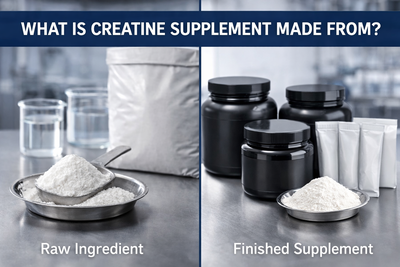
If you are sourcing creatine for a private label brand, evaluating a supplier, or simply trying to understand what is really inside a creatine supplement, it helps to separate three different things:
the creatine compound itself
the finished supplement formula
the supporting ingredients used for production, flavor, or delivery format
That distinction makes the category much easier to understand.
Creatine Supplements Are Usually Made From Creatine Raw Material in Powder Form
In most commercial products, a creatine supplement is made from a bulk creatine raw material supplied as a fine white powder. The most common form by far is creatine monohydrate.
This is the standard ingredient used in many sports nutrition products because it is widely recognized, relatively stable in powder applications, and suitable for a broad range of formulations including unflavored powder, flavored drink mixes, capsules, and sachets.
So when someone asks what creatine supplement is made from, the most direct answer is this:
Most creatine supplements are made from creatine monohydrate raw material, which is then packed directly or blended with other ingredients depending on the finished product design.
For a very simple creatine powder product, the ingredient list may only contain one active ingredient. In that case, the finished supplement is essentially made from purified creatine monohydrate plus the packaging system used to deliver it safely.
What Is Creatine Itself Made From?
This is where some confusion often appears.
People sometimes ask whether creatine supplements are made from meat, animal tissue, or natural food extracts. That question comes from the fact that creatine is naturally found in foods such as red meat and fish, and it is also present in the human body.
However, the creatine used in commercial supplements is generally not obtained by directly grinding meat or extracting it from whole foods for retail supplement production. In modern supplement supply chains, creatine is typically supplied as a purified ingredient produced at the raw material level and then sold to supplement manufacturers for use in finished products.
That means the creatine in a supplement jar is usually a processed raw material intended for manufacturing, not simply a powdered food ingredient.
From a practical B2B perspective, what matters most is not whether creatine exists naturally in food, but whether the supplied creatine raw material is consistent, tested, and appropriate for the intended finished formula.
The Most Common Creatine Ingredient Is Creatine Monohydrate
If you look at creatine products across the market, creatine monohydrate remains the most common version.
This matters because the question “what is creatine supplement made from” often leads to a second question: are all creatine supplements made from the same type of creatine?
The answer is no.
While creatine monohydrate is the dominant option, some products use alternative forms such as:
- creatine hydrochloride
- buffered creatine
- creatine blends
- performance formulas that combine creatine with amino acids, electrolytes, or pre-workout ingredients
Still, in the mainstream market, creatine monohydrate is the form most buyers will encounter. For many manufacturers and private label brands, it is also the most practical starting point because it is familiar to the market and easier to position.
A Finished Creatine Supplement May Contain More Than Just Creatine
Not every creatine product is a single-ingredient formula.
Some creatine supplements are made from only one active ingredient, while others include additional components to improve taste, convenience, or product positioning.
Depending on the format, a creatine supplement may also contain:
- natural or artificial flavors
- sweeteners
- anti-caking agents
- acids for flavor balance
- capsule shell materials
- excipients for filling or flow improvement
- functional ingredients such as B vitamins, electrolytes, taurine, beta-alanine, or amino acids
This is an important point for buyers.
When people ask what creatine supplement is made from, they may expect one simple answer. But in real manufacturing, the answer depends on the product format.
For example:
A plain unflavored powder may contain only creatine monohydrate.
A flavored sports drink powder may contain creatine plus flavor system ingredients.
A creatine capsule product may contain creatine plus capsule shell and processing support materials.
A performance blend may contain creatine as only one part of a larger formula.
So the label format and product concept matter just as much as the core ingredient itself.
What Are the Supporting Ingredients in Creatine Products?
Supporting ingredients are not necessarily the main selling point, but they still affect the product in important ways.
In manufacturing, these supporting ingredients help with:
- taste
- texture
- powder flow
- moisture control
- filling performance
- capsule compatibility
- shelf presentation
- user convenience
For example, an unflavored creatine monohydrate powder may need very little support beyond proper packaging. A flavored creatine formula, on the other hand, may need a carefully designed flavor system and good anti-caking control to stay stable and easy to use.
This is why two creatine products with the same headline ingredient can still feel very different in the market.
One may dissolve better.
One may taste cleaner.
One may clump faster in humid conditions.
One may fill more consistently during production.
One may offer a simpler label for buyers who prefer a minimalist formula.
These are all formulation and manufacturing decisions, not just marketing details.
Is Creatine Supplement Made From Natural Ingredients?
This depends on what people mean by “natural.”
Creatine is a naturally occurring compound in the body and in certain foods, but the creatine used in supplements is normally supplied as a refined manufacturing ingredient rather than as a direct food powder. Because of that, many creatine products occupy a middle ground in buyer perception: they are based on a compound that exists naturally, but the supplement ingredient itself is processed for commercial use.
For B2B brands, this question matters because “natural” positioning often affects packaging language, customer expectations, and category strategy. A brand targeting clean-label sports nutrition may present creatine very differently from a brand targeting aggressive pre-workout performance marketing.
From a factory perspective, it is better to focus on clear documentation, raw material specifications, and finished product quality rather than relying too heavily on vague wording.
What Is the Difference Between Creatine Raw Material and a Finished Creatine Supplement?
This is one of the most useful distinctions for importers and private label buyers.
Creatine raw material
This is the bulk ingredient used for manufacturing. It usually arrives in larger quantities, accompanied by technical documents and batch specifications.
Finished creatine supplement
This is the market-ready product sold in jars, pouches, stick packs, or capsules under a brand name.
A buyer who understands this difference can make better sourcing decisions.
If you are buying bulk ingredient only, your concerns may focus on purity, testing, and supply stability.
If you are buying finished private label creatine, your concerns expand to include formula design, packaging, branding, lead time, label compliance, and final presentation.
The raw material is only the starting point. The finished supplement is the result of both ingredient quality and manufacturing execution.
Common Finished Formats of Creatine Supplements
Creatine supplements can be made into several finished formats, and each format changes the ingredient system slightly.
| Format | Main Ingredient Structure | Typical Notes |
|---|---|---|
| Unflavored powder | Mostly creatine monohydrate only | Clean label, simple positioning |
| Flavored powder | Creatine plus flavor system | More formulation work required |
| Capsules | Creatine plus capsule shell | Convenient daily use |
| Sachets or stick packs | Creatine with or without supporting ingredients | Travel-friendly and portion-controlled |
| Blended sports formulas | Creatine plus multiple active ingredients | Positioned for performance support |
This is why asking what creatine supplement is made from should always be followed by another question: what kind of creatine product are we talking about?
Without that context, the answer can be incomplete.
Why Raw Material Quality Matters So Much in Creatine Products
Creatine looks simple, but simple products often make quality differences easier to notice.
If the formula only contains one major active ingredient, then raw material quality becomes even more visible. Problems such as poor flowability, unusual texture, clumping, inconsistent particle size, or weak documentation are harder to hide when the product concept is basic.
For that reason, manufacturers usually pay close attention to:
- raw material identity
- purity consistency
- microbiological status
- heavy metal control
- appearance and color
- moisture-related performance
- behavior during blending and filling
A creatine supplement may have a short ingredient list, but it still depends on a disciplined quality system.
What Buyers Should Look for on a Creatine Label
If you are reviewing creatine products for sourcing, private label development, or competitor analysis, look beyond the front label.
Key things to review include:
- the exact type of creatine used
- whether the formula is single-ingredient or blended
- serving size clarity
- added flavors or sweeteners
- packaging suitability for powder stability
- supporting documentation such as COA availability
- whether the product positioning matches the actual formula
This matters because two products can both claim to be creatine supplements while being quite different in composition and market strategy.
One may be a basic bulk powder.
Another may be a flavored daily-use formula.
Another may be positioned as a premium sports nutrition system with additional actives.
The ingredient story changes with the product concept.
Final Thoughts
So, what is creatine supplement made from?
In most cases, it is made from creatine raw material in powder form, most commonly creatine monohydrate. Depending on the finished product, that core ingredient may be packed on its own or combined with flavors, sweeteners, capsule materials, or other functional ingredients.
The important thing is to understand that “creatine supplement” can describe both a very simple single-ingredient product and a more developed sports nutrition formula. The raw material may be straightforward, but the finished supplement still depends on sourcing quality, formulation choices, and manufacturing control.
For buyers, brand owners, and importers, that means the right question is not only what creatine supplement is made from, but also how the ingredient is specified, tested, and turned into a finished product that performs well in the market.
FAQ
Is creatine supplement made from meat?
Creatine is naturally found in foods such as meat and fish, but commercial creatine supplements are usually made from purified creatine raw material used in modern supplement manufacturing rather than directly from powdered meat.
What is the most common ingredient in creatine supplements?
The most common ingredient is creatine monohydrate. It is widely used in powder, capsule, and sports nutrition formulas.
Do all creatine supplements contain only creatine?
No. Some products contain only creatine, while others also include flavors, sweeteners, capsule materials, or additional performance ingredients.
Is creatine monohydrate the same as a finished creatine supplement?
Not exactly. Creatine monohydrate is usually the raw active ingredient, while the finished supplement may also include packaging, flavor systems, or delivery-format ingredients.
Why does ingredient quality matter in creatine supplements?
Because many creatine products are simple formulas, raw material quality, consistency, and testing standards can have a direct effect on product performance and customer experience.