

A bottle may list vitamins A, B, C, D and E across the front. That still leaves several important questions unanswered.
Which B vitamins are included? How much does one full serving provide? What forms of those vitamins are used? Does the formula contain minerals, sugar, flavors, or other active ingredients?
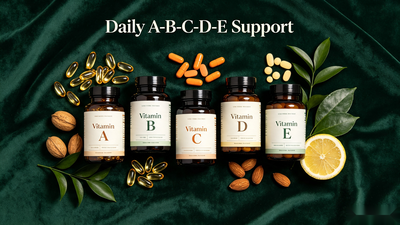
A vitamin A B C D E supplement is usually a type of multivitamin, but products with nearly identical names can have very different formulas. The Supplement Facts panel gives a clearer picture than the letters printed on the front label.
“Vitamin B” Is Not One Ingredient
Vitamin B is a group of eight separate nutrients:
-
B1 — Thiamin
-
B2 — Riboflavin
-
B3 — Niacin
-
B5 — Pantothenic acid
-
B6
-
B7 — Biotin
-
B9 — Folate
-
B12
These are commonly referred to as the B-complex vitamins, but a multivitamin does not always include all eight.
One product may contain the complete B-complex group. Another may include only B6, folate, and B12. A third may provide small amounts of most B vitamins but place extra emphasis on biotin or B12.
Two bottles can therefore say “A, B, C, D and E” on the front while containing completely different B-vitamin profiles.
The only reliable way to know what is included is to read each nutrient listed in the Supplement Facts panel. A general “Vitamin B” claim is not specific enough.
What Is Actually Included in the Formula?
There is no universal formula for a multivitamin. Manufacturers choose which nutrients to include, the amount of each nutrient, and the ingredient forms used.
The label may show forms such as:
| Nutrient | Examples You May See on the Label |
|---|---|
| Vitamin A | Retinyl palmitate, retinyl acetate, beta-carotene |
| Folate | Folic acid or another folate form |
| Vitamin B12 | Cyanocobalamin or methylcobalamin |
| Vitamin C | Ascorbic acid or related forms |
| Vitamin D | Vitamin D2 or vitamin D3 |
| Vitamin E | Tocopherol or tocopheryl acetate |
These names identify the actual materials used in the formula. They should not be treated as decorative label language.
A product may also contain ingredients beyond vitamins A through E, including:
-
Calcium, iron, zinc, or magnesium
-
Herbal extracts
-
Amino acids
-
Sweeteners
-
Flavors and colors
-
Fillers, binders, or coating materials
The NIH Office of Dietary Supplements notes that multivitamin products do not follow one standard composition. This is why the complete ingredient list matters.
How to Read the Supplement Facts Panel
A useful reading order is:
Serving size → individual B vitamins → amount per serving → % Daily Value → vitamin form → Other Ingredients
1. Start With the Full Serving Size
Nutrient amounts are normally shown per serving, not necessarily per tablet, capsule, gummy, or dropper.
One serving might be:
-
One tablet
-
Two capsules
-
Three gummies
-
One teaspoon
-
One full dropper
A bottle containing 60 gummies may provide only 20 servings if the daily serving is three gummies.
Serving size also changes how much sugar, sweetener, flavor, and other supporting ingredients a person consumes each day.
Before comparing two products, make sure the nutrient amounts are based on equivalent daily servings.
2. Check Which B Vitamins Are Included
Do not assume that a product contains the complete B-complex group.
Look for the individual names:
-
Thiamin
-
Riboflavin
-
Niacin
-
Pantothenic acid
-
Vitamin B6
-
Biotin
-
Folate
-
Vitamin B12
This also helps distinguish a broad multivitamin from a product focused mainly on B12, folate, or biotin.
A formula with all eight B vitamins is not automatically better than one with fewer. It simply represents a different product design. The important point is that the label makes the coverage clear.
3. Compare the Amount and % Daily Value
The amount column shows how much of a nutrient is provided in one serving. The % Daily Value, or %DV, helps place that amount in context.
As a general label-reading guide:
-
5% DV or less is considered low;
-
20% DV or more is considered high.
The FDA Daily Value guide is useful for comparing labels, but %DV is not a personalized intake recommendation.
One product may provide:
-
100% DV of vitamin C
-
50% DV of vitamin D
-
200% DV of vitamin B6
-
500% DV of vitamin B12
That pattern may reflect the product concept, ingredient cost, serving-size limits, or marketing position. It does not automatically mean the higher numbers are more suitable.
4. Look at Vitamin Forms and Other Ingredients
The vitamin form can help explain why two products with similar nutrient names are not identical.
For example, one formula may use vitamin D3 while another uses vitamin D2. One may list methylcobalamin as the B12 source, while another uses cyanocobalamin.
The form should be reviewed together with:
-
Amount per serving
-
Product format
-
Stability
-
Target user
-
Other ingredients
The Other Ingredients section also matters. Gummies may contain sugars, syrups, acids, flavors, and gelling ingredients. Tablets may use binders, coatings, and flow agents. Liquid products may require flavors, preservatives, or stabilizers.
Is a Higher Dose Always Better?
No.
A high percentage on the label may look impressive, but more is not automatically more appropriate.
Vitamins B and C are water-soluble, while vitamins A, D, and E are fat-soluble. These nutrients are not handled in exactly the same way, and they do not need to appear at matching percentages in a multivitamin.
The more practical concern is repeated intake.
Someone may use:
-
A daily multivitamin
-
A separate vitamin D supplement
-
A B-complex product
-
An immunity gummy
-
A fortified drink or powder
Several of these products may contain the same nutrients. The total intake across all products matters more than the number shown on one label.
The NIH also advises consumers to consider the possibility of excessive intake when multivitamins are combined with other supplements and fortified foods.
A Quick Label Comparison
Consider two fictional products:
| Label Detail | One-Tablet Formula | Two-Gummy Formula |
|---|---|---|
| Serving size | 1 tablet | 2 gummies |
| Vitamin D | 100% DV | 50% DV |
| Vitamin B12 | 400% DV | 100% DV |
| Vitamin E | 100% DV | 40% DV |
| B-vitamin coverage | All 8 B vitamins | B6, folate, and B12 |
| Vitamin D form | D3 | D2 |
| Vitamin B12 form | Methylcobalamin | Cyanocobalamin |
| Added sugar | None | 3 g |
Illustrative example only.
The tablet covers more B vitamins and contains no added sugar. The gummies may be easier to take and may suit someone who dislikes swallowing tablets.
Neither option is automatically better. The useful comparison is based on the full serving, nutrient coverage, vitamin forms, supporting ingredients, and the user’s existing supplement routine.
What Brands Should Decide Before Formulation
A multivitamin project should begin with a clear product purpose, not the longest possible ingredient list.
Brands need to answer five practical questions:
-
Who is the product designed for?
-
Which B vitamins are actually needed?
-
What amount and %DV should one serving provide?
-
Which dosage form can carry the formula realistically?
-
What labeling, stability, and testing requirements apply?
A formula can look compact in a spreadsheet but become impractical once tablet size, gummy flavor, mineral bulk, or daily capsule count is considered.
Adding another vitamin may look attractive on a sales sheet, but it also takes up label space, affects raw-material handling, and creates another stability and testing requirement.
The final formula should work as a product, not just as an ingredient list.
The Bottom Line
Do not judge a vitamin A B C D E supplement by the front label alone.
Check which B vitamins are included, the full serving size, the amount and %DV of each nutrient, the vitamin forms, and the Other Ingredients section. Then compare the formula with any other supplements used regularly.
A clear, practical formula is more useful than a label built around the largest possible numbers.
Frequently Asked Questions
Does a vitamin A B C D E supplement contain all eight B vitamins?
Not always. Vitamin B refers to a group of eight nutrients, but a product may contain only some of them. Check the individual B vitamins listed in the Supplement Facts panel.
Does a higher %DV mean a better multivitamin?
No. %DV helps consumers compare nutrient amounts, but a higher percentage does not automatically make a product more appropriate. Serving size, total intake, nutrient form, and other supplements also matter.